
Our Work / Recruitment & Staffing
CV screening, interview scheduling and candidate updates for a recruitment agency
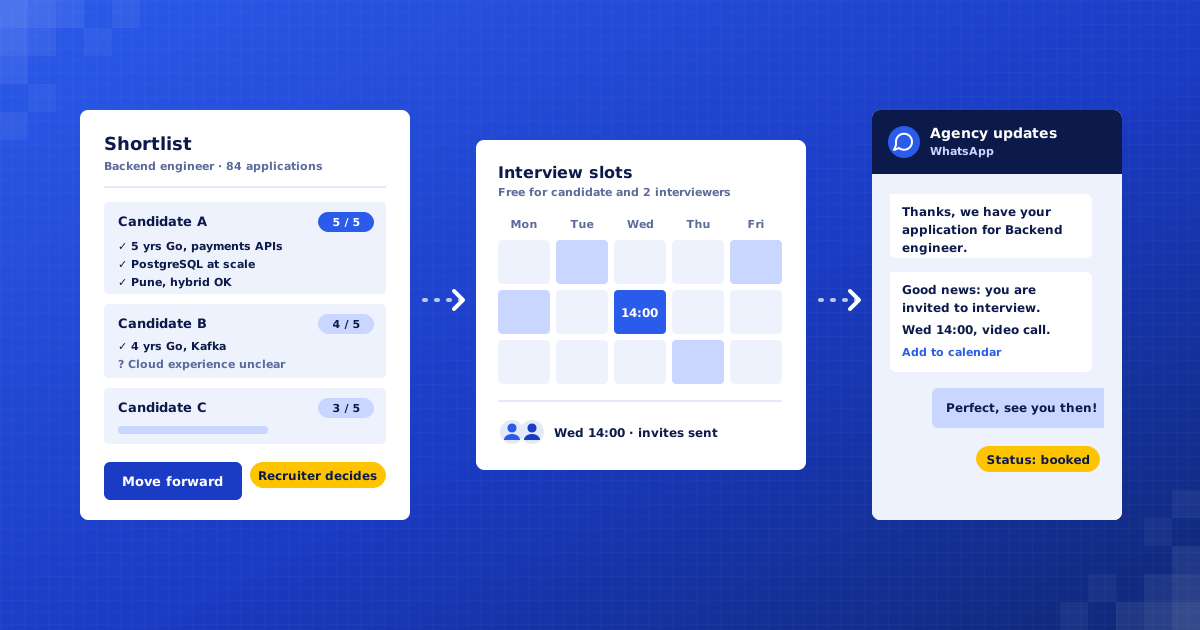
An example agency gets CVs screened against each job's agreed criteria into a ranked shortlist with reasons, interviews scheduled automatically and candidates kept updated on WhatsApp.
Example project · Updated
The problem
A 15-person recruitment agency in Mumbai filling tech and finance roles for about 30 mid-sized companies.
- Give recruiters a ranked shortlist with clear reasons, against criteria the client agreed.
- Book interviews without the back-and-forth.
- Keep every candidate informed at each stage, and start each role with a complete brief.
How it works
Shortlist Desk, step by step
- 01Client job intakeTally Forms
- 02Agree the screening criteriaRecruitee
- 03Collect applicationsn8n
- 04Screen against the criteriaClaude
- 05Ranked shortlist with reasonsRecruitee
- 06Schedule interviewsCal.com
- 07Keep candidates updatedWhatsApp Business API
- 08Weekly pipeline reportGoogle Sheets
Full project details +Hide details −
The situation
They have around 60 open roles at any time and receive roughly 3,000 applications a month from job boards, LinkedIn and referrals. Recruiters read CVs by hand, arrange interviews over email and phone, and update candidates when they find time. New roles arrive from clients by email in every format imaginable.
Screening eats the week. A recruiter reading 100 CVs for one role spends most of a day on it, and good candidates sit unread while the pile grows.
Scheduling is a chain of emails. Matching a candidate's availability with two or three hiring managers takes several messages per interview and often a few days.
Candidates hear nothing. Most applicants never get a status update, which hurts the agency's reputation and means strong people accept other offers while waiting.
Job briefs arrive incomplete. Clients send a job title and a salary range by email, and recruiters chase the must-haves, location and interview panel before they can start.
Each step
1. Client job intake. Clients fill in a short form for each new role: title, must-have and nice-to-have skills, experience, location, salary band, interview stages and panel. The form creates the job in the ATS and flags anything missing to the account manager.
2. Agree the screening criteria. The recruiter and client confirm the criteria in plain language before screening starts. Only job-related criteria are allowed. Name, age, gender, religion, caste, marital status, photos and other protected characteristics are never used.
3. Collect applications. Applications from job boards, LinkedIn, the agency's careers page and referral emails land in the ATS. Duplicate candidates are matched by email and phone so one person is one record.
4. Screen against the criteria. Claude reads each CV against the role's agreed criteria and writes a short note: which must-haves are met, which are unclear, and which are missing. Personal details are stripped before screening. It does not reject anyone.
5. Ranked shortlist with reasons. The recruiter sees candidates ranked by fit, each with its reasons, and can open any CV. The recruiter decides who goes forward, who is held and who is declined. Unclear cases are marked for a closer look rather than ranked low.
6. Schedule interviews. Once a recruiter moves a candidate forward, the candidate gets a link with slots that suit every interviewer on the panel, with time zones handled. Reschedules and cancellations update everyone's calendar automatically.
7. Keep candidates updated. Candidates get a message on WhatsApp or email when their application is received, when they are shortlisted, when an interview is booked, and when a decision is made. Decline messages are written by the recruiter's template and sent only after the recruiter confirms.
8. Weekly pipeline report. Each client gets a weekly summary per role: applications, shortlisted, interviewed and offers, plus anything waiting on them, such as feedback from a hiring manager.
What we build
Job intake form. Captures each role's criteria, panel and stages from the client in one go.
CV screening assistant. Checks CVs against agreed job criteria and explains each match.
Shortlist view. A ranked list with reasons, where recruiters decide who goes forward.
Interview scheduler. Books interviews from real panel availability and handles changes.
Candidate update flow. Sends status messages on WhatsApp or email at every stage.
Connects to: Recruitee, Claude, n8n, Cal.com, Google Workspace, Microsoft 365, WhatsApp Business API, Tally Forms, Google Sheets.
People stay in control
Recruiters decide who goes forward. The system ranks and explains; it never rejects a candidate on its own.
Clients and hiring managers make every hiring decision.
Screening uses only the job criteria agreed with the client, never protected characteristics, and the criteria are reviewed for each role.
Recruiters regularly sample screened CVs, including low-ranked ones, to check the reasoning holds up.
Rollout
Week 1: Audit the process. Map how roles arrive, how CVs are screened today and how interviews are booked. Pick five open roles for the pilot.
Weeks 2–3: Build intake, screening and scheduling. Set up the client intake form, connect the ATS and calendars, and write the screening notes format with the recruiters.
Week 4: Screen alongside recruiters. For the pilot roles, recruiters screen as usual while the system screens in parallel. We compare the two and fix where they disagree.
Weeks 5–6: Go live and extend. Turn on scheduling and candidate updates for the pilot roles, then bring the remaining roles and clients on in groups.
Where the value comes from
Faster shortlists. Recruiters start from a ranked list with reasons instead of an unread pile, so shortlists reach clients sooner.
Less scheduling admin. Interviews are booked from real availability, replacing the chain of emails per candidate.
Fewer lost candidates. Regular updates keep good candidates engaged while the process runs, instead of drifting to other offers.
Consistent, explainable screening. Every candidate is checked against the same agreed criteria, with a written reason a recruiter can review.
Complete briefs from day one. The intake form gathers what recruiters need before work starts, cutting the chasing at the beginning of each role.
What to measure: Days from role opening to shortlist sent; Days from shortlist to first interview; Recruiter hours per role filled; Candidate drop-out rate between stages; Share of screening notes recruiters disagree with.
Your numbers
What could this be worth to you?
These are your inputs, not our claims. Change any number to match your business.
Time and money saved, estimated
₹75,000
per month · ₹9,00,000 per year
About 150 hours of manual work handled for you each month.
What does it cost?
We give a fixed quote after a free 30-minute audit, once we know your ATS, role volumes and how clients send you jobs.
Is AI screening fair to candidates?
Screening uses only the job criteria agreed with the client, personal details are removed first, and every reason is written down for a recruiter to check. It ranks and explains; recruiters and clients make the decisions.
We use a different ATS. Does that matter?
No. The same design works with most ATS tools that have an API, such as Zoho Recruit, Workable or Greenhouse. We confirm the details in the audit.

Find your first automation in 30 minutes.
Free audit. Fixed quote after. No surprises.
Book free audit ↗