
Work / Tech & SaaS
An AI sales rep that answers every demo request in under a minute
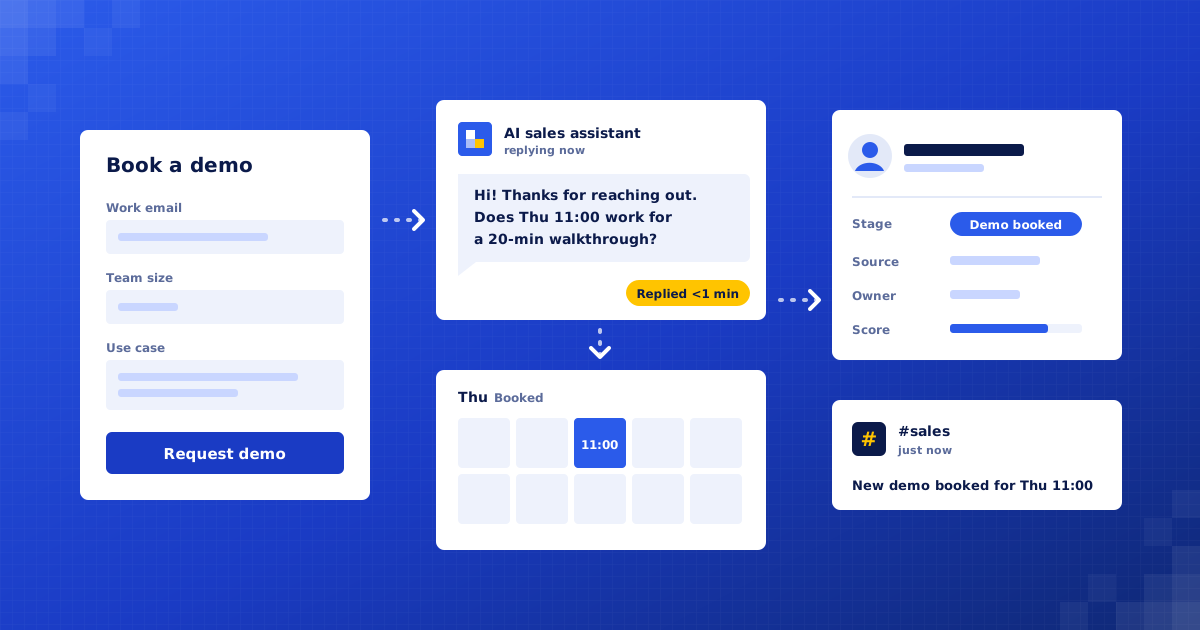
An example B2B SaaS team gets an AI SDR that replies to demo requests in under a minute, books calls, and drafts researched outbound for human approval.
The problem
A 40-person B2B SaaS company in Pune selling scheduling software to mid-sized logistics firms in India and Europe.
- Reply to every inbound demo request, day or night, in under a minute.
- Put only qualified buyers on the sales calendar, with research attached.
- Send more researched outbound without lowering quality or losing human sign-off.
How it works
Pipeline Autopilot, step by step
- 01Capture every requestn8n
- 02Enrich and screenClearbit / Apollo
- 03First reply in under a minuteClaude
- 04Qualify against clear rulesClaude
- 05Book the right AECal.com
- 06Log and alertHubSpot + Slack
- 07Outbound research and draftsClaude + Slack
- 08Learn from repliesHubSpot
Full project details +Hide details −
The situation
They get about 300 inbound demo requests a month through a website form and a pricing-page chat. Two SDRs triage these by hand in HubSpot, alongside cold outreach to a list of around 1,500 target accounts. Replies go out when someone gets to them, which can be the next working day.
Speed decides who gets the meeting. A buyer who fills in three demo forms on a Friday evening usually books with whoever replies first. Here, weekend and after-hours requests wait until Monday.
The SDRs spend most of the morning on triage: checking whether a request is a real company, looking it up on LinkedIn, removing students and competitors, and copying details into HubSpot. That is time not spent talking to buyers.
Outbound is thin. Writing a properly researched first email takes 15 to 20 minutes per account, so the team either sends generic templates that get ignored or sends very few.
Duplicates and gaps creep into the CRM. The same person books twice under different emails, or a lead from the chat widget never makes it into HubSpot at all.
Each step
1. Capture every request. Website form, pricing-page chat and email enquiries all land in one n8n workflow. The contact is matched against HubSpot by email and company domain, so a repeat request updates the existing record instead of creating a duplicate.
2. Enrich and screen. The company domain is enriched with size, industry and country. Free-mail addresses, students, competitors and obvious spam are filtered into a separate low-priority queue rather than deleted.
3. First reply in under a minute. Claude writes a short, specific reply in the buyer's language, confirms what they asked about, and asks the one or two qualifying questions still missing, such as fleet size or current tool. It never quotes prices or promises features.
4. Qualify against clear rules. Answers are scored against rules the sales lead agreed in advance: company size, region, use case and timeline. Anything ambiguous is marked for a human instead of guessed.
5. Book the right AE. Qualified buyers get a booking link routed by region and round-robin, with time zones handled. If they do not book within a day, one polite reminder goes out, then the sequence stops.
6. Log and alert. The deal, conversation and research notes are written to HubSpot. The assigned AE gets a Slack message with a one-paragraph brief before the call.
7. Outbound research and drafts. For each target account, the agent reads the company site, recent news and job posts, then drafts a first email that refers to something real. Drafts sit in a Slack approval queue. Nothing is sent until an SDR approves or edits it.
8. Learn from replies. Replies are classified as interested, not now, wrong person, or unsubscribe. Unsubscribes are honoured at once across every sequence. Weekly, the team reviews which angles got replies and the prompts are adjusted.
What we build
Inbound SDR agent. Replies, qualifies and books inbound demo requests around the clock.
Account research agent. Builds a short brief per target account from public sources.
Slack approval queue. Where SDRs approve, edit or reject every outbound draft in one click.
Dedupe and routing layer. Matches contacts to existing HubSpot records and assigns the right AE.
Weekly pipeline digest. A Monday summary of requests, bookings, no-shows and reply themes.
Connects to: HubSpot, Slack, Claude, n8n, Cal.com, Google Workspace, Apollo, Intercom.
People stay in control
Every outbound email is approved or edited by an SDR before it is sent.
Borderline or high-value leads are flagged to a person instead of auto-qualified or rejected.
The sales lead owns the qualification rules and can change them without a rebuild.
Any buyer can ask for a human, and the agent hands over with full context.
Rollout
Week 1: Audit the funnel. Map every lead source, read a sample of past requests, and agree the qualification rules and tone with the sales lead.
Weeks 2–3: Build both agents. Connect HubSpot, calendars and Slack. Build the inbound flow first, then the outbound research and approval queue.
Week 4: Shadow mode on real leads. The agent drafts replies for live requests but SDRs send them. We compare its judgement with theirs and fix the gaps.
Weeks 5–6: Go live and tune. Inbound replies go out automatically. We review conversations weekly, tighten prompts and adjust routing.
Where the value comes from
More demos from the same traffic. Buyers who would have booked with a faster competitor get a useful reply while they are still on your site.
SDR time moves to selling. Triage, lookup and data entry are done before a person sees the lead, so SDR hours go to calls and follow-ups.
Fewer wasted AE calls. Unqualified requests are filtered or redirected before they reach the calendar, and each call starts with a brief.
More outbound without generic spam. Research and drafting are automated, so the team can send more personalised emails while still approving each one.
A cleaner CRM. Every request is deduplicated and logged with its source, which makes pipeline reports trustworthy.
What to measure: Median time to first reply on inbound requests; Inbound request to booked demo rate; Demo show rate; Outbound reply rate on approved drafts; Share of leads needing human review.
Your numbers
What could this be worth to you?
These are your inputs, not our claims. Change any number to match your business.
Extra revenue, estimated
₹4,50,000
per month · ₹54,00,000 per year
About 1.8 extra leads won each month at your numbers.
What would this cost us?
We give a fixed quote after a free 30-minute audit, once we know your lead sources, CRM and volumes.
Will buyers know they are talking to AI?
Yes. The agent says it is an assistant and offers a human at any point. Being upfront tends to work better than pretending.
We use Pipedrive, not HubSpot. Does that matter?
No. The same design works with Pipedrive, Salesforce, Zoho or a custom CRM with an API. We confirm the details in the audit.

Find your first automation in 30 minutes.
Free audit. Fixed quote after. No surprises.
Book free audit ↗