AI chatbot for customer support: what it can and can't do
An honest look at AI support agents: the questions they handle well, and where a human should always take over.

Henil Mehta · Automation Expert
· 4 min read
Short answer
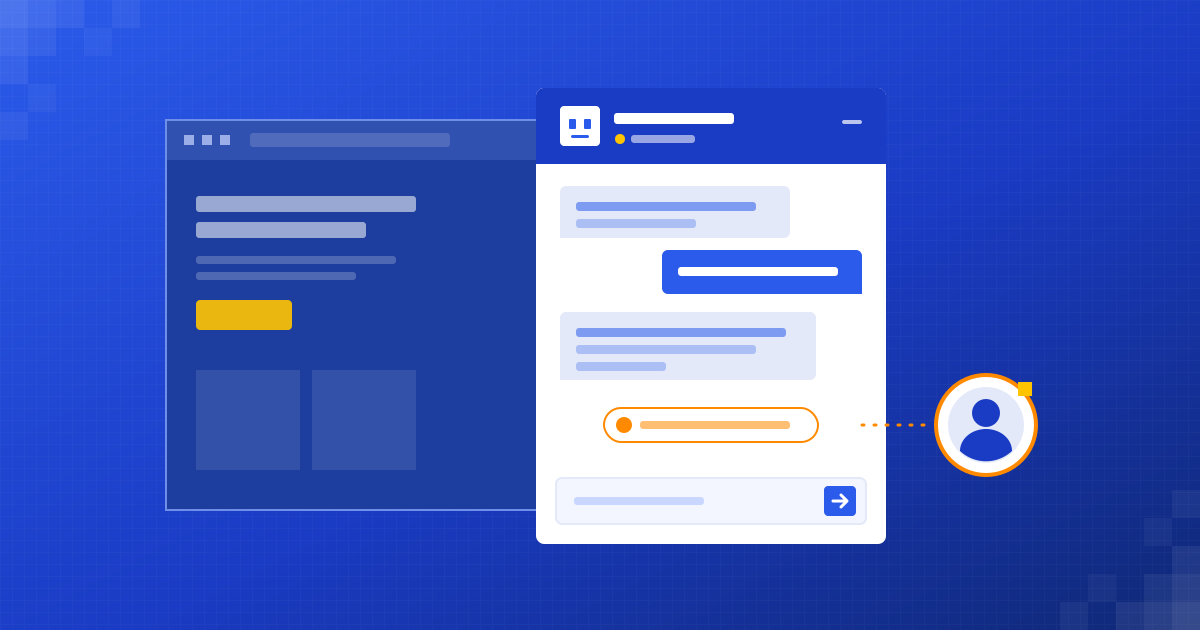
A good AI support chatbot answers common customer questions instantly, day or night, using your own information such as prices, policies, opening hours and order status. It works on your website, WhatsApp or email and writes like a person rather than a menu of buttons. It should not guess, handle complaints or make promises it can't check; those go to a human with the full conversation attached.
Why do support questions eat so much time?
Where's my order? Are you open on Sunday? Do you deliver to my postcode? Can I change my booking?
None of these are hard. That's the problem. They're easy, they're constant, and each one breaks someone's focus. Your best people end up as a human FAQ page.
Scroll back through last week's inbox and count. There's a good chance most messages are some version of the same handful of questions.
What can an AI support agent actually do?
A well-built AI support agent is closer to a trained new starter than an old chatbot. It reads the question, finds the answer in your information and replies in plain language.
- Answer questions about opening hours, delivery, returns, pricing and services.
- Look up order or booking status in your shop or booking system.
- Collect details for a request, like a callback or a quote, and pass them on.
- Reply in the customer's language.
- Work on your website chat, WhatsApp and email, using the same knowledge everywhere.
It answers from what you give it: your website, your policies, a help document, your product list, your Shopify store. Not from whatever it finds on the internet.
What should it never do?
This matters more than the clever bits. A support agent that confidently gets things wrong is worse than no agent at all.
- Guess. If the answer isn't in your information, it says so and hands over.
- Handle complaints, refunds or anything emotional on its own.
- Make promises about prices, discounts or dates it can't check.
- Pretend to be a person if the customer asks.
“I'm not sure, let me get someone who knows” is a perfectly good answer. A confident wrong one isn't.
When it hands over, your team gets the full conversation and a short summary, so the customer doesn't have to explain themselves twice.
How is this different from old chatbots?
Old chatbots followed rigid scripts. Press 1 for delivery, press 2 for returns. Ask anything slightly different and you got stuck in a loop.
Modern AI understands normal questions written the way people actually write them, typos and all. “hey did my parcel go out yet, ordered tues” is fine. It finds the order, checks the status and answers.
The rules around it still matter, though. We set clear limits on what it can say and when it must hand over. The AI handles the language. The rules handle the safety.
It also needs looking after. Prices change, policies change, new products arrive. Someone on your team should own the information it answers from and update it when things move. That's usually a few minutes a week, not a new job.
What does it look like for a real business?
How do you get started?
- Scroll through last month's messages and list your ten most common questions.
- Write down the correct answer to each, or point to where it already lives.
- Decide which topics must always go to a person.
- Launch on one channel first, usually the one with the most volume.
- Read the conversations every day for the first couple of weeks and fix anything that's off.
If you'd like a second pair of eyes, book our free 30-minute audit. We'll look at the questions your customers actually ask, tell you honestly how much of it an AI agent could handle, and send you a short written summary and a fixed quote afterwards.
Questions people ask
Can an AI chatbot answer questions about my specific business?
Yes. It answers from information you provide, such as your website, policies, price list and order system, rather than general internet knowledge.
What happens when the AI doesn't know the answer?
It should say so and hand the conversation to a person on your team, with the full chat and a short summary attached.
Can an AI support agent work on WhatsApp?
Yes. The same agent can answer on WhatsApp, your website chat and email, using one shared set of information.
Will an AI chatbot replace my support team?
No. It takes the repetitive questions off their plate so they can spend time on complaints, tricky cases and customers who need a real conversation.
Written by
Henil Mehta
Automation Expert at Dizilus. You talk to the people who build your automations, not a sales rep.