AI receptionist for clinics: WhatsApp booking, reminders and no-shows
What a WhatsApp AI receptionist can and can't do for an Indian clinic, what the research says about reminders and no-shows, and the rules you need to follow.

Henil Mehta · Automation Expert
· 8 min read
Short answer
An AI receptionist for clinics answers patients on WhatsApp, books, reschedules and cancels appointments straight into your live calendar, and sends reminders before each visit. Reminders help (a Cochrane review found text reminders raised attendance from 67.8% to 78.6%), but a 2024 Indian trial of one-way WhatsApp reminders found no significant change. So I'd use two-way reminders, where the patient can reschedule in the chat and the slot goes back on the calendar. Symptoms, medical questions and emergencies should always go to your staff or doctor.
The phone rings while three WhatsApp messages wait
Picture a 3-chair dental clinic in Ahmedabad at 6:30 in the evening. The receptionist is on the phone explaining parking to one patient, two people are waiting at the counter, and three WhatsApp messages asking for tomorrow's slots sit unread. At 10 pm another one arrives: "Kal subah ka time mil sakta hai?" Nobody sees it until 10 the next morning.
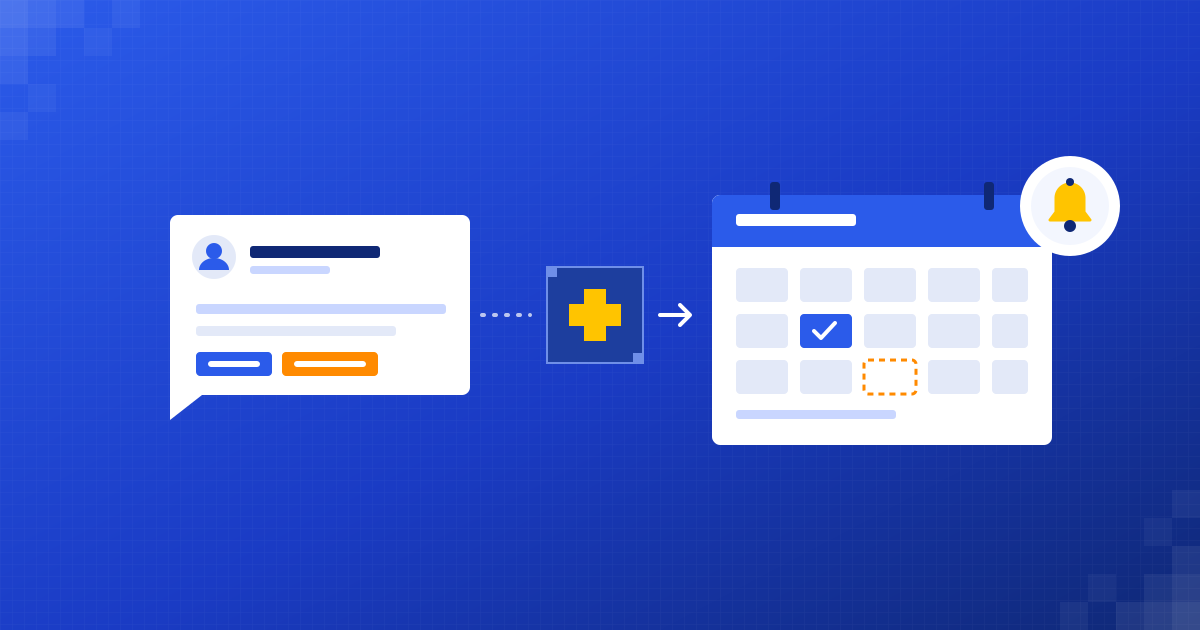
That's the gap an AI receptionist for clinics is meant to close. It replies on WhatsApp in seconds, books the slot into your calendar, reminds the patient before the visit, and hands anything clinical to a person.
If you're weighing up an AI receptionist for clinic bookings, here's what it can and can't do, what the research says about no-shows, and the WhatsApp and DPDP rules vendor pages tend to skip.
What an AI receptionist for clinics can and can't do
It handles the admin side of a patient's message. Here's where I'd let it work alone:
- Answer timing, location and "which doctor is in on Saturday" questions from information you've approved.
- Show open slots and book one into your calendar.
- Reschedule or cancel when the patient asks, and release the slot.
- Send reminders and confirmations before the visit.
- Reply in Hindi, Gujarati or the language the patient wrote in.
And here's where it should stop and hand over:
- Any symptom, medicine or "is this normal?" question. It acknowledges the message and passes it to your staff or doctor.
- Anything that sounds like an emergency. It tells the patient to call the clinic or emergency services right away and alerts staff.
- Reports, prescriptions, and angry or confused patients. A person replies, with the chat history in front of them.
The handover works the same way as in the WhatsApp support agents we build: /automation/support/.
How does it book, reschedule and cancel without double-booking?
It has to be connected to your live calendar: Google Calendar, practice software or a booking tool, as long as everyone uses the one diary.
When a patient picks a slot, a well-built bot rechecks it at the moment it confirms and writes the booking straight away. If your front desk gave that slot away by phone a minute earlier, the bot offers the next one.
If your appointments live in a paper register at the counter, fix that first. A bot can't avoid double-booking against a diary it can't read.
Do WhatsApp reminders actually reduce no-shows?
Yes, on balance, but less dramatically than vendor pages suggest. Here's what the studies say:
- A Cochrane review (2013) covered 8 trials with 6,615 people. Attendance was 67.8% with no reminder and 78.6% with a text reminder. Phone calls did about the same (80.3%), and in two studies texts cost 55% and 65% less per attendance than phone calls. The evidence is low to moderate quality and over a decade old.
- A 2024 trial with 388 patients with uncontrolled blood pressure at two public sub-district hospitals in Punjab sent WhatsApp reminders 3 days and 1 day before the follow-up visit. Attendance was 21.8% with the reminders and 19.6% without. That 2.2-point gap wasn't statistically significant (p = 0.603).
- A 2026 survey of 100 patients who missed OPD appointments at a tertiary hospital found the top reasons were forgetting and not getting a reminder. Distance wasn't a significant factor.
- A 2024 systematic review put outpatient no-show rates between 12% and 42%. The further ahead the booking, the more no-shows: 8% at 0 to 3 days out versus 22% at 28 to 30 days in one study it cites.
My read: a reminder fixes forgetting. It does little for patients who can't come, and a one-way message can't change that. Several Indian vendors publish their own no-show figures; treat those as claims until you see the setup behind them.
Why one-way reminders aren't enough
This part is my view, not a study result: let the patient act inside the same chat. A reminder with Confirm, Reschedule and Cancel buttons turns a silent no-show into something you can act on. A reschedule keeps the patient.
A cancellation two days out gives you the slot back with time to refill it. A no-show gives you nothing.
When should the reminders go out?
Vendors commonly send reminders 24 hours and 2 hours before the visit. The Punjab trial used 3 days and 1 day. Neither is proven best, so here's what I'd start with:
- Booked a week or more ahead: a confirm-or-reschedule message 2 to 3 days before, so a freed slot can still be refilled.
- Every appointment: a reminder the day before with the buttons above.
- Same-day visits: a short message 2 hours before with the map link and what to bring.
Then adjust based on what gets replies. One study cited in the 2024 review found 50.5% of patients preferred phone-call reminders and 46.7% SMS, so for patients who never reply on WhatsApp, a staff call still has its place.
The WhatsApp rules: the 24-hour window and message templates
WhatsApp is the obvious channel here. India is its largest market, with over 500 million users.
- When a patient messages you, a 24-hour customer service window opens. Inside it, the bot can reply freely.
- Outside it, you can only send pre-approved templates. A reminder for a booking made last week has to be a template.
- Templates are categorised. Utility templates are tied to something the user did, like booking, and must not be promotional. Add an offer and it becomes a marketing template.
- Meta reviews approved templates and can move them to marketing. Since April 2025, a template you submit as utility that Meta judges to be marketing gets approved as marketing from the start.
My reading is that a plain appointment reminder fits the utility category. Keep it that way: no "20% off teeth whitening this month" tacked on the end.
Patient data on WhatsApp and the DPDP Rules
The Digital Personal Data Protection Rules were notified on 14 November 2025, with compliance phased in over 18 months from November 2025. For a clinic using a WhatsApp bot, the parts that matter most:
- Ask for consent with a separate, clear notice that says what you'll use the data for, like appointment booking and reminders.
- Let patients withdraw that consent at any time, and stop messaging them when they do.
- If there's a data breach, tell the affected patients without delay, and report it to the Data Protection Board.
- Answer patients' requests about their data within 90 days.
- Penalties go up to ₹250 crore for failing to protect data and up to ₹200 crore for failing to report a breach.
In practice, I'd keep the bot to name, phone number, doctor and slot. No diagnoses or reports in the chat. Less data means less to protect. This isn't legal advice, so run your consent wording past someone who knows the Rules.
Does a small clinic need the WhatsApp Business API?
One vendor guide (HumAI) suggests that under roughly 20 to 30 chats a day, the free WhatsApp Business app covers most needs. For a solo GP, that's fair.
But the free app can't run an AI receptionist. It can't connect a bot to your calendar or send automated template reminders. For that you need the WhatsApp Business Platform, usually through a provider.
My rule of thumb: if your receptionist answers WhatsApp comfortably between patients, stay on the app. If messages pile up in the evening or reminders don't go out, move.
How to set up an AI receptionist for your clinic, step by step
- Count the problem for two weeks: WhatsApp enquiries per day, how many arrive after hours, and how many booked patients don't turn up.
- Move to one live calendar that the front desk and the bot will both use.
- Write the bot's answer sheet (timings, doctors, address, what to bring) and have staff approve every line.
- Write handover rules: symptoms, medicines, reports and emergencies go to a named person.
- Set up the WhatsApp Business Platform number and get your reminder templates approved as utility.
- Add a consent message to the first conversation, with a simple opt-out.
- Run it alongside your front desk for two to four weeks, reading every conversation, before it confirms bookings alone.
- Compare your no-show rate and after-hours bookings with the numbers from step 1.
Want to see how this would work at your clinic?
We build WhatsApp receptionists that book into your existing calendar, send two-way reminders and hand clinical questions to your team. See how it works for healthcare providers at /automation-for/healthcare/. If you'd like us to look at your clinic's setup, we'll tell you honestly whether you need one yet.
Questions people ask
Can an AI receptionist give medical advice to patients?
It shouldn't. A well-built clinic bot handles booking, timings, location and reminders. Any question about symptoms, medicines or reports goes to your staff or doctor, and anything that sounds urgent gets an instruction to call the clinic or emergency services.
Can the bot reply in Hindi or Gujarati?
Yes. Current language models reply well in Hindi, Gujarati and other Indian languages, and can match the language the patient writes in. Have a native speaker review replies in the first few weeks.
How much do WhatsApp reminders reduce no-shows?
A Cochrane review found text reminders raised attendance from 67.8% to 78.6%, but a 2024 Indian trial of one-way WhatsApp reminders found a 2.2-point difference that wasn't statistically significant. That's why I'd use two-way reminders that let patients reschedule or cancel in the chat.
Is it safe to collect patient details on WhatsApp under DPDP?
It can be, if you take clear consent for a specific purpose, let patients withdraw it, collect only what booking needs and keep clinical details out of the chat.
Written by
Automation Expert at Dizilus. You talk to the people who build your automations, not a sales rep.